Comparing Thermal and Multi-Test Moissanite Diamond Testers
Anyone who has worked with loose stones for more than a few weeks learns one thing quickly: appearances can be misleading. Under showroom lighting, a well-cut moissanite can easily imitate the brilliance of a natural diamond. That is exactly why diamond testers have become standard tools in jewelry workshops, pawn shops, and gem trading counters. Yet not all testers operate in the same way. Thermal testers and multi-test moissanite diamond testers approach stone identification from very different angles, and understanding the difference can save both time and expensive mistakes.
Traditional thermal diamond testers focus on heat conductivity. Diamonds transfer heat extremely fast compared to most simulants, so these devices measure how quickly heat moves through the stone. For many years, this method worked well because cubic zirconia and glass behaved very differently from diamonds. A thermal tester could separate them within seconds.
The challenge appeared when moissanite entered the market. Moissanite also conducts heat efficiently, sometimes close enough to diamond that older thermal testers struggle to distinguish between the two. A jeweler relying only on a basic thermal tester may receive a “diamond” reading from a moissanite stone, especially with high-quality modern cuts. In busy retail environments, that can create awkward situations with customers or inaccurate pricing decisions.
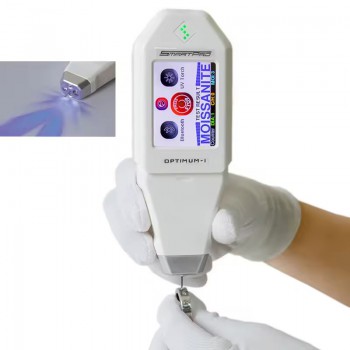
This limitation pushed manufacturers toward multi-test technology. Multi-test moissanite diamond testers combine thermal conductivity with electrical conductivity analysis. Diamonds conduct heat well but are poor electrical conductors, while moissanite behaves differently under electrical testing. By comparing both measurements together, the device can identify stones with far greater precision.
In practical use, the difference becomes noticeable immediately. A thermal tester often gives a simple pass-or-fail style response. Multi-test devices usually provide more detailed feedback and reduce uncertainty during evaluation. For jewelers handling mixed inventories, estate jewelry, or secondhand stones, that extra layer of confirmation can be extremely valuable.
Another factor worth considering is workflow efficiency. Thermal testers are generally simpler and slightly faster. Many are compact, affordable, and easy for beginners to understand. Small repair shops that rarely encounter moissanite may still find them perfectly adequate for routine checks.
Multi-test units, however, are designed for broader real-world conditions. They tend to perform better when stones are mounted in jewelry, where metal settings can interfere with readings. Higher-end models also compensate for ambient temperature changes and improve accuracy on smaller stones. These details matter when evaluating expensive pieces under pressure.
Cost naturally enters the conversation as well. Thermal testers usually occupy the lower end of the price range, making them attractive for startups or hobby users. Multi-test moissanite diamond testers cost more, but many professionals view them as a worthwhile investment because they reduce misidentification risks. One incorrect evaluation can easily outweigh the difference in purchase price.
Neither tool is completely perfect on its own. Even advanced testers should not replace proper gemological inspection, especially for high-value stones. Magnification, certification, and professional experience still play important roles. Testers are best viewed as efficient screening tools rather than final authorities.
Choosing between the two ultimately depends on the type of work being done. For occasional stone verification, a thermal tester may cover basic needs. For businesses regularly dealing with moissanite, lab-grown stones, or customer trade-ins, a multi-test device offers a safer and more reliable solution. In today’s jewelry market, where gemstone technology keeps advancing, precision matters more than ever.


Comments
Post a Comment